Posts

Image
The Dead Sea treasure hoard of Nahal Mishmar Nahal Mishmar sceptre (image from Wikipedia) The Nahal Mishmar treasure hoard discovered in 1961 includes the oldest known crown in the world and an ornate sceptre. Found inside a cave bordering the Dead Sea (not far from the Dead Sea Scrolls) and about 11 km from the Ein Gedi Temple ruins, they are stunning examples of Chalcolithic age copper work using the 'lost wax' method.  The hoard consists of over 400 objects thought to have been stashed following the abandonment of the Ein Gedi Temple. Many objects, including the crown and sceptre, are obviously ceremonial with signs of wear and repair. Therefore, they are thought to be considerably older than the reed mat in which they were wrapped. The sequence of events leading to their storage is unknown, but possibly it was an attempt to hide the precious objects from marauding invaders. The symbolism, including on the crown and sceptre, is notable for depictions of i...
Image
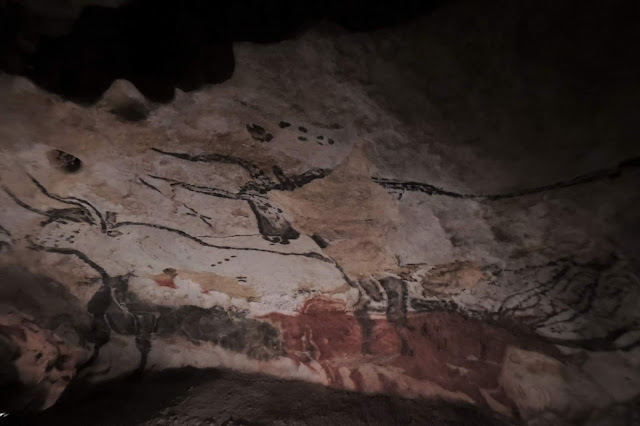
The importance of Palaeolithic art Example of European Palaeolithic art - from Wikipedia With our decoding of European Palaeolithic animal symbols as star constellations - probably similar to ones we continue to use today - we have initiated a new method for tracking the dispersal of people and ideas. This complements existing methods based on comparison of DNA, language, mythology and specific artefacts (such as stone tools and pottery). I discuss some of the implications in Prehistory Decoded. Comparison of DNA is probably the most useful of these methods because it is practically unlimited in terms of time depth, and it can distinguish between migration and cultural diffusion, i.e. the movement of people vs the diffusion of ideas. The archaeological record, in terms of tools etc, is probably the next most useful. The comparison of zodiacal symbols is similar to comparative mythology - we should probably view them as two sides of the same coin. But it is perhaps a little ...
Image
Excellent review of Prehistory Decoded at Cosmic Tusk
Image
The Origin of Writing, part 3 The general view is that writing began almost simultaneously in Egypt and Sumer around 3000 BC. As far as I know, scholars think it began first in Sumer, and transferred to Egypt shortly after. A popular theory, due to Schmandt-Besserat, is that writing evolved out of symbols used to record trade in the 4th millennium BC in Mesopotamia. I'll try to show here that this is only part of the story - writing also developed from astronomical notation. A great resource is the book 'Visible Language' by Chris Woods from the Oriental Institute of the University of Chicago. It describes the transition to writing in both Mesopotamia and Egypt with copious illustrations of relevant artefacts. Rather than copying its images, you can obtain a pdf freely here . It focuses on the symbols used in each place just before writing appears in the historical record, around, 3500 to 3000 BC. Since writing emerges as a 'logographic' script initially, ...
Image
What happened to the builders of Gobekli Tepe? Genetic correspondence between ancient and modern populations of the Near East and North Africa, from Schuenemann et al., Nature Comms. 2017. Gobekli Tepe was gradually abandoned between around 9,000 to 8,000 BC, right at the beginning of the Neolithic revolution. Presumably, other, newer cultural centres gained from Gobekli Tepe's loss. But where did its people go? In earlier posts I highlighted the connections between symbolism at Gobekli Tepe and Ancient Egypt. It appears almost as though the Ancient Egyptians are the most direct descendants of the people who constructed Gobekli Tepe. Is this where they went? Clearly, we have the similarity in megalithic architecture. And Ancient Egypt is not so far from southern Anatolia. The fertile banks of the Nile would probably have been very inviting compared to the hard hills of southern Turkey. I have already outlined the correspondence between the animal symbols at Gobekli ...
Image
The Origin of Writing, Part 2 Left: Pillar 2 at Gobekli Tepe (image courtesy of Alistair Coombs), Middle: an Ancient Egyptian cartouche (image from Wikipedia), Right: stone plaquette found at Gobekli Tepe (image courtesy of Alistair Coombs) True writing appears almost simultaneously in Ancient Sumeria and Ancient Egypt shortly before 3000 BC. But various forms of proto writing are known from around 6000 BC. Proto writing is a set of symbols used to convey a limited type of information, whereas true writing can convey any meaning - it is essentially speech made visual. Klauss Schmidt, who discovered Gobekli Tepe, thought its pillars, especially on their narrow faces, exhibited a very early form of proto-writing. He thought their pictures told stories. He also suggested the Uraeus (snake) symbol of Ancient Egypt might have derived from the snake symbols at Gobekli Tepe. I suspect he was right. The orthodox view of writing popular among archaeologists , proposed by Schmandt-Be...
Image
The origin of writing Necklace on Pillar 18 at Gobekli Tepe (courtesy of Alistair Coombs) The origin of writing has long fascinated scholars for obvious reasons. The dominant theory presently is that writing began in Mesopotamia, around 3200 BC, probably in the city of Uruk, thought to be the largest urban area ever built up to that time. Writing begins in Egypt soon after, it is generally thought, although given that archaeologists have only scratched the surface of the Earth, all claims of 'prior art' must be treated with extreme caution. Nevertheless, Schmandt-Besserat's theory of writing's origin in Mesopotamia has gained considerable traction. Partly, it is so popular, I think, because it nicely confirms a bias in modern scholarship towards Marxism, i.e. that everything can be explained by the relationship between power and trade. You see, Schmandt-Besserat's theory proposes that writing grew out of trading systems involving tokens and clay tablet...
Image
Ancient Sumerians knew about precession too The Uruk Vase (from Wikipedia) In recent weeks I have shown how the Ancient Egyptians must have known about our ancient zodiac and precession of the equinoxes. I've now begun to look at ancient Mesopotamia. There are many obvious links between them which I'll present in the coming weeks. However, in this first look at ancient Sumer I want to focus on one of its oldest and most important artefacts, the Uruk Vase. A series of Stone-Age cultures inhabited the Euphrates and Tigris river valleys after the Younger Dryas period. This region includes much of present-day Iraq and Syria to the west of the Zagros Mountains. After the 8.2 kiloyear event archaeologists have labelled these people the Halaf, Samarra, Hassuna  and Ubaid cultures, which combined take us up to around 3800 BC. After this, in southern Mesopotamia, we have the Uruk period which then takes us into Bronze Age Sumer around 3100 BC. Uruk is thought to be ...
Image
Talking about Prehistory Decoded with Mike And Maurice https://www.youtube.com/watch?v=UqDExxEX8j0
Image
A note on Precession of the Equinoxes (now on YouTube https://www.youtube.com/watch?v=rAen0kZly78&t=39s) A few people have contacted me about an error in my calculations for precession of the equinoxes using Stellarium. In each case, it appears they are making the same mistake I made when I set out on this journey, as described in Prehistory Decoded. So, in this post I want to explain how to use Stellarium to do these calculations. But before I begin, I should also point out that Stellarium is perfectly capable of making these calculations without any significant inaccuracy over the timescales we are interested in, i.e. 40,000 years or so. Gobekli Tepe's archaeologists have claimed that Stellarium might not be suited to this task. But they are wrong. I certainly agree that I would not use Stellarium to back-calculate the position of the moon (for visualising ancient eclipses, for example) over this timescale. But this problem does not apply to calculation of preces...
Image
New paper from the Comet Research Group confirms comet impact Distribution of sites at which the Younger Dryas boundary layer has been found (Pino et al., Scientific Reports, vol. 9, p4413 (2019)). The latest paper, published in Scientific Reports here , from the Comet Research Group and colleagues in Chile provides yet more evidence the Younger Dryas event was a comet impact. Like their others, this new paper is extensive and detailed, this time providing 10 different streams of evidence for the Younger Dryas boundary layer at Pilauco, Chile. It means severe effects from this event were felt across nearly half the world's land surface, and perhaps more. These new results are especially interesting for a couple of reasons, in my view. We already knew the Younger Dryas event happened - there is no doubt about that. We also know it caused the Younger Dryas mini ice-age - a period of around 1,300 years from 12,900 to 11,600 BC - when northern hemisphere temperatures plummet...
Image
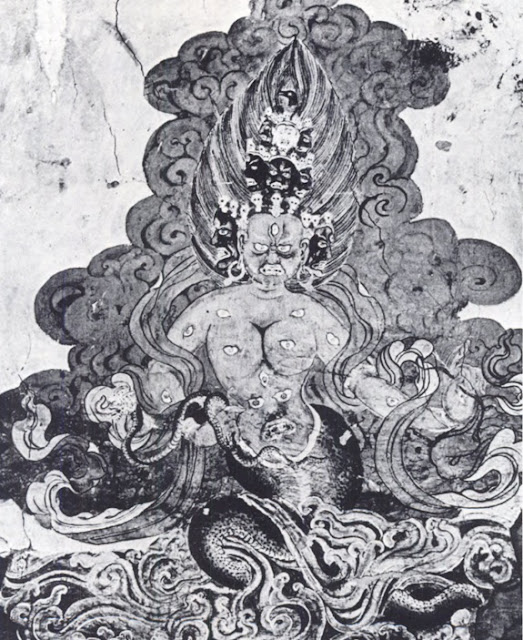
Comets in ancient myth Figure 1 from Balaji Mundkur's 'The Cult of the Serpent' In Prehistory Decoded I make the case that much of the world's mythology, ancient and modern (known as religion), is connected by an ancient system of astro-mythology, largely focussed on comets - their appearance and catastrophic effects. If true, we should see comet symbolism throughout myth and religion, from before Gobekli Tepe into modern Christianity. So where is it? It should be everywhere. If you Google 'ancient comets' you'll see a wide variety of shapes and depictions for comets through the ages. There is the standard 'menat'-shaped comet through to fox-tail shapes, scimitars, rosette shapes, tridents, and so on. They come in all sorts of shapes, sizes and colours. So how would this translate into religious symbolism? Moreover, their catastrophic effects, such as a massive explosive airburst, would take on different symbolism. Mike Baillie, a leadin...
Image
Clube and Napier's Coherent Catastrophism, and Wikipedia My new book is founded on Clube and Napier's coherent catastrophism. They are both formerly Professors of Edinburgh (where I am now - complete coincidence) and Oxford. Bill Napier is an astronomer specialising in cometary science while Victor Clube is an astrophysicist. They first published on this subject, to the best of my knowledge, in 1979. But it was not until the early 1980s that they developed their 'terrestrial theory of catastrophism'. It was later, in the early 1990s I think, that their collaborator, Duncan Steel, coined the term 'coherent catastrophism', and that's how their theory is now popularly known. Together with David Asher and Mark Bailey, these five scientists have pioneered research into their alternative view of cosmic catastrophism on Earth - one based on comets rather than asteroids. The evidence they have accumulated is compelling, but controversial. I give some of the ...
Image
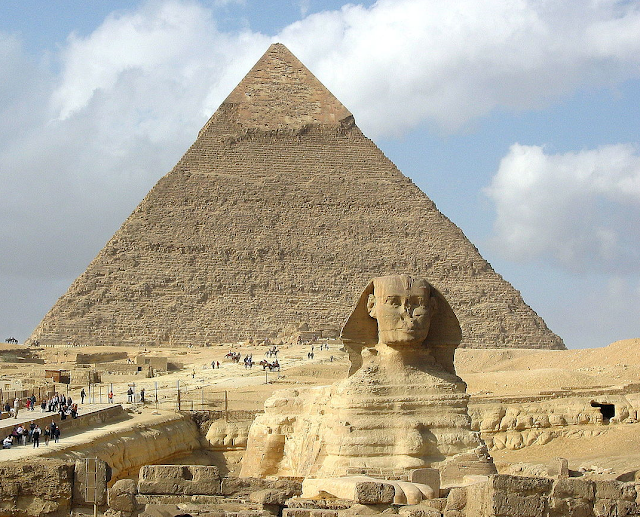
The prehistory of Ancient Egypt The Narmer Palette (from Wikipedia) History became legend. Legend became myth. Not sure who said this first, but Galadriel was spot-on when it comes to Ancient Egypt. The history of Ancient Egypt is fairly well known. The various king lists tell us about the royal dynasties, and there are plenty of temples, monuments, tombs and other remains with their hieroglyphs to piece together a coherent story. Beginning with the Ptolemaic period around 300 BC, and going backwards, it is generally agreed that Ancient Egypt has nearly 3000 years of history, comprising over 30 dynasties. These dynasties are divided into Kingdoms interrupted by 'intermediate' periods, probably caused by war, famine or another catastrophe. The precise dates of these dynasties are still contested by some, who prefer to shoehorn Ancient Egyptian history into a timeline that agrees with biblical scripture, or astronomical events, or some other uncertain clue. Nonethele...
Image
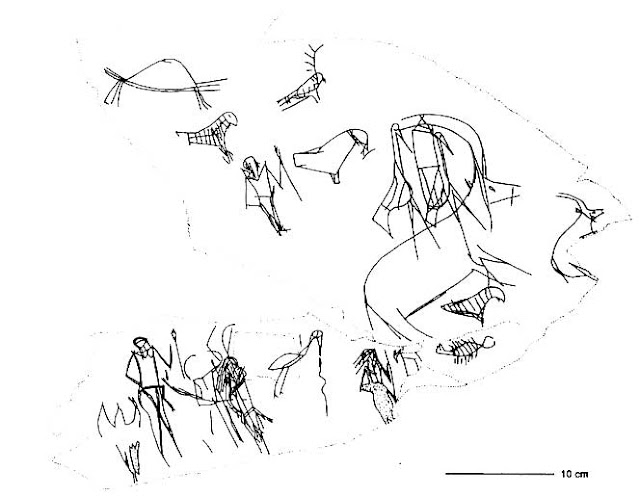
Another nail in the coffin of the Scorpion King The above image is a copy of some rock graffiti found by John and Deborah Darnell, Egyptologists at Yale University, in the Egyptian desert, about 25 miles north west of Thebes. In Prehistory Decoded, I partially decode the lower portion of this scene. Now, I want to show how the whole scene can be decoded. We begin with the falcon-scorpion pair on the bottom right. As shown in an earlier post, the falcon-scorpion pair likely indicate the autumn equinox is transitioning between the Sagittarius and Scorpius constellations, and therefore represent the date 3500 BC, to within a few hundred years. Darnell, suggests this pair represents the name of the Scorpion King, because the falcon (the symbol for Horus) often means 'King', or pharaoh, when followed by another symbol in hieroglyphics. The problem is that this scene, along will all supposed 'Scorpion King' inscriptions, predate the invention of hieroglyphics by hundr...
Image
Great review of Prehistory Decoded by Timothy Williams
Image
Pillar 43 - the Horus Stone? Left: Pillar 43 from Gobekli Tepe (courtesy of Alistair Coombs). Right: wine? jar recovered from the Scorpion King's grave, Cemetery U-j, Abydos, by Gunther Dreyer (Director of the German Archaeological Institute in Egypt), image from Wikipedia. I discuss the Scorpion King in 'Prehistory Decoded' as I quickly trace the pre-history of Ancient Egypt back to its supposed origins around 6000 BC - just after the 8.2 kiloyear event. He is thought to be involved, somehow, in the unification of Egypt, circa 3200 BC. But it is not clear whether there actually was any king named Scorpion, or what role he played in Egypt's history, or exactly when he lived. Evidence for his existence is mainly interpreted from inscriptions on a variety of recovered objects that involve a falcon, or Horus, symbol above a scorpion symbol. In Egyptian hieroglyphics the Horus (falcon) symbol often precedes the name of a king, or pharaoh, which is why this ...
Image
Origin of the Egyptian Gods (Image from Wikipedia) There's a nice article here about the origin of the Ancient Egyptian gods by Caroline Seawright, an archaeology student. It dovetails nicely with what I say in 'Prehistory Decoded'. The only thing I would change is the reason predynastic Egyptians from different regions of Egypt chose their specific animal 'guardians', or patrons. Caroline repeats the orthodox view that the animals chosen either had agricultural value or were fierce or dangerous in some way. Again, while there might be some truth to this, the deeper reason is probably that they were the zodiacal signs used by each specific community, representing either a solstice or equinox. The Ancient Egyptians were, after all, very keen on astronomy, and as I show in 'Prehistory Decoded', this tradition likeky goes back many tens of thousands of years in Europe. One (of many) piece of evidence to support this idea are the Cippus of Horus...
Image
New paper featured in international news My new paper, with Alistair Coombs, on Palaeolithic cave art, including Chauvet, the Lascaux Shaft Scene and the Lion-man of Hohlenstein-Stadel cave, featured on the science pages of international newspapers and websites today, such The Times, Telegraph, Daily Mail, Express and India Today. Read all about it!
Image
Paper accepted My new paper, with Alistair Coombs, "Decoding European Palaeolithic art: Extremely ancient knowledge of precession of the equinoxes" has been accepted and published online, see https://www.athensjournals.gr/ajhis/forthcoming . In this work, we show that it is likely that; A Palaeolithic zodiac and precession of the equinoxes were already known during the last ice age. The Lascaux Shaft Scene likely memorialises another impact with the Taurid meteor stream This tradition lasted into the Neolithic period, e.g. at Gobekli Tepe and Catalhoyuk.