Posts

Symbolic links between Gobekli Tepe and Catalhoyuk (updated)

Image
There are numerous symbolic links between Catalhoyuk (Central Turkey, 7100-6000 BCE) and Gobekli Tepe (southern Turkey, ~10,000-8000 BCE) that show they probably knew the same (or similar) astronomical zodiacal system. The Master/Mistress-of-Animals First, see here for a list of known 'Master/Mistress-of-Animals' symbols from around the Near Eastern region. Above is a 3rd millennium BCE example from Ur, Mesopotamia. We also have a Mistress-of-Animals, or Potnia Theron, at Catalhoyuk (above). This shows symbolism from the 8th millennium BCE survived until the Bronze and Iron Ages. We now also have a Master-of-Animals at Sayburc, one of the Tas Tepeler sites and only around 25 km from Gobekli Tepe (above). This suggests it is possible for symbolism to survive from the time of Gobekli Tepe through to the Bronze and Iron ages too. If these symbols can survive this long, then so can constellations and their symbols. Catalhoyuk Wall Reliefs Now consider that at Catalhoyuk, there are...

Does Jericho have astronomical alignments?

Image
From Barkai and Liran, Time and Mind 1, 273-284 (2008). Barkai and Liran (2008) suggest the stone tower at Jericho was an astronomical observation platform, used primarily for tracking the setting sun on the summer solstice. Jericho, an early Neolithic town excavated by Kathleen Kenyon's team in the 1950's, is famous for its massive stone tower and walls. The tower was built around 8000 BCE, meaning it overlapped with Gobekli Tepe. A remarkable feat for the time. The tower, like the great Pyramids of Egypt, is penetrated by a shaft with apparent astronomical alignments. In this case, the shaft forms a set of very steep stairs. Their orientation (azimuth) is around 290 degrees, quite close to the summer solstice sunset at this latitude and time (299 degrees). However, anyone climbing the stairs would have exited at the top and faced almost directly towards  Mount Quruntul with its conical peak at 1300 m. In fact, the sun sets on the shoulder of Quruntul, at azimuth 293 degrees, ...

Ophiuchus at Tepe Guyan?

Image
  Above are three stone plaquettes from Tepe Guyan, Iran, 5th millennium BCE (from Wikipedia). On the left is a likely Master-of-Animals. Note the triangular anthropomorphic body holding two snakes, a common Master-of-Animals motif. In the middle is probably the same deity/constellation with the same triangular body wrestling a long snake with stars in the background. But note the long beak looking to (our) right. On the right is probably the same figure again, also wrestling a long snake with more stars in the background and some V-symbols. These are clearly the same constellation, probably a pre-cursor to Ophiuchus. They suggest that early versions of Ophiuchus imagined the constellation symbol to have the head of a long-beaked bird, and a triangular shaped body. Above is a scene from Stellarium, showing that Ophiuchus is the autumn equinox constellation from around 4100 BCE to 3600 BCE. Before 4100 BCE, the autumn equinox constellation is Sagittarius, and after 3600 BCE it is Sc...

How old is Gobekli Tepe? (updated)

Image
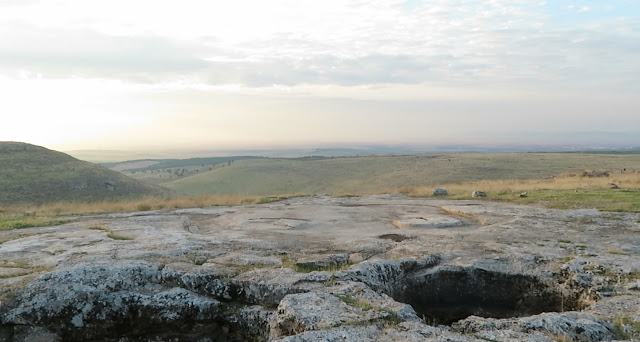
  Enclosure E, outside the main excavation area. In an earlier post I suggested the earliest phase of construction of GT could be in the Younger Dryas period. This is because enclosure D is so well crafted and so large, that it is unlikely to have been the first construction of its kind. Other enclosures must have preceded it, acting as templates or precursors for its design. Given that ground penetrating radar scans show that other large structures remain to be uncovered, and that the enclosures excavated so far represent only 5-10% of the site, it seems unlikely we have excavated the oldest parts already. This idea is reinforced by the existence of enclosure E outside the main excavation area. It seems to be a rougher and less precise example than enclosure D, and so could be a precursor. Since it is missing its walls and pillars, it is possible they were re-used in the construction of enclosure D. It has not been radiocarbon dated. But what about scientific evidence? Let's consi...

Stonehenge: Solar calendar or not?

Image
  Figure 8A from T. Darvill (2022), "Keeping time at Stonehenge", Antiquity 96, 319-335. Last year, Timothy Darvill's paper made the headlines: Stonehenge could have been used as a solar calendar. It seemed to make a lot of sense. After all, solsticial alignments and calendars go together, like cheese and biscuits, and Stonehenge is famous for its solsticial alignments. Indeed, Darvill suggested the calendar was kept in time by observing the summer sunrise or winter solstice (or both). This is the way it was supposed to work; If we consider only the large megaliths of the 'Stage 2' construction, circa 2620-2480 BCE, then... 1. There are apparently 30 upright stone megaliths in the outer Sarsen ring. Although many are missing now. there is archaeological evidence for all of them. These can obviously be used to count the days of each 30-day month. 2. Do this 12 times and you get 360 days. 3. The final 5 'epagomenal' days can be counted with the trilithon hor...

Interview with Sammy on YouTube, on the Younger Dryas impact and Gobekli Tepe

Image
  Had a good chat with Sammy. Thanks Sammy!

Interview with Jordan Youkilis on his "Entangled" podcast

Image
 Available on  spotify . Enjoy.

James Powell's response to Mark Boslough regarding the destruction of Tall el-Hammam

Image
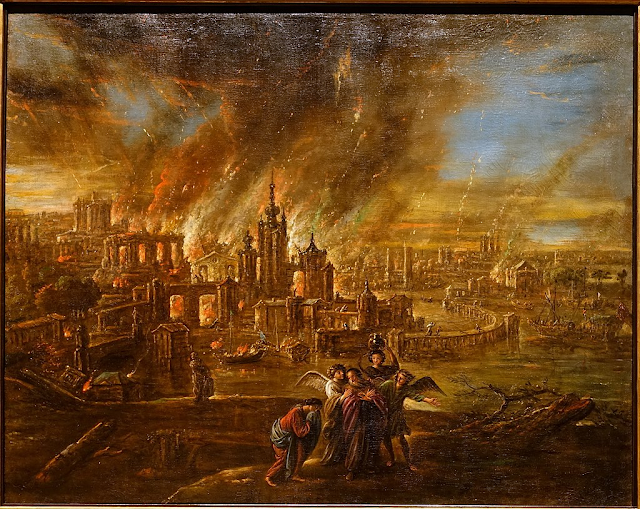
Sodom and Gomorrah afire, by Jacob de Wet 11, from Wikipedia James Powell , an eminent geologist, now retired, has just published an excoriating review of Mark Boslough's  criticism of the recent  Tall el-Hammam paper , one of the most widely read scientific papers of the last decade. This paper argues that a cosmic impact destroyed Tall el-Hammam circa 1650 BCE. This event might have been remembered in Biblical terms as the destruction of Sodom. Rather than critiquing this paper in the usual way through publishing a peer-reviewed rebuttal, Mark instead published his ad-hominem-laden review in the Skeptical Enquirer, a magazine published by the Committee for Skeptical Enquiry (CSI) (oddly, it has the tagline "The Magazine for Science and Reason"). Much of his article was a targeted attack against a member of the Comet Research Group, Allen West. You can see much the same kind of attack on Allen on the talk page of Wikipedia's article on the Younger Dryas Impact Hypo...

Wikipedia's bias - a case study: The Younger Dryas impact hypothesis

Image
Wikipedia is notoriously biased on some subjects. You can find plenty of information about Wikipedia's biases through Google. Also see this video by one of Wikipedia's founders,  Larry Sanger . Plenty of other videos like this can be found . The Younger Dryas impact hypothesis Wiki page, along with several related pages, provide clear examples of this bias. One reason this bias occurs is because Wikipedia is not scientific. Wikipedia is written by its editors. These editors decide which sources should be promoted and which should be neglected according to their judgement about how reliable each source is - they discuss these issues on the associated 'talk' pages. However, these editors are frequently not scientists or academics themselves and can be strongly biased. This means they often use unreliable sources, here-say, or simply their own opinion in reaching these decisions. This is not how science works. Scientists, like most academics, are trained to evaluate the q...