Posts

Gobekli Tepe's Pillars

Image
Significance: Gobekli Tepe (GT) probably played an important role in the origin of civilisation. Most of us are connected to it in some way, through language and religion (proto-Nostratic?), or genetics at least. The Pillars: GT is famous for its anomalous megalithic pillars, and especially the symbols carved on them. Most people think these symbols are telling an important story - they are not just random pictures of animals. Klauss Schmidt, who discovered GT and led its excavation, until his death in 2014, certainly thought so. It follows that the only way we will ever be able to properly understand Gobekli Tepe, and therefore the origin of civilisation, is through reading its pillars. Deutsche Archaeological Institute : the DAI operates the Gobekli Tepe dig. Despite the immense significance of the site, only around 20 are documented by the DAI. Although many have no symbols, even 25 years after the site's discovery there is no single resource available that describes all its pi...
Image
Excellent review of Prehistory Decoded by Alistair Coombs
Image
An equilateral triangle at Gobekli Tepe? A recent paper by Hacklay and Gopher claims to have found evidence of geometric planning in the construction of Gobekli Tepe’s enclosures. Their paper received a lot of media attention, and seems to have gone relatively unchallenged, at least so far. Their central claim is this: that three of the circular enclosures uncovered so far at Gobekli Tepe were deliberately planned to form an equilateral triangle with a preferred orientation. The above illustration shows nicely what they mean. Now this is published in a top archaeological journal – the Cambridge Archaeological Journal, so it must be right. Right? Wrong. Its actually pure speculation. Let’s see what they really did. They locate the position of the centre of each pillar around the three circular enclosures, B, C and D, and then use a mathematical technique to work out the geometric centre of each enclosure. The method is this. They work out the distance from the assumed centr...
Image
New paper on Zodiacal Dating published Recently published online in the Athens Journal of History . This paper tracks some cases of the zodiacal dating system, from Palaeolithic cave art, circa 15,000 BC, through the Picts circa 500 AD. It also links Pictish symbols with the Ancient Egyptian gods. Enjoy.
Image
Does the Lascaux Shaft Scene document a cosmic impact in the Late Middle Magdalenian? C alibrated radiocarbon chronology for multiple Magdalenian sub-phases  and the Magdalenian - Azilian transition in Spain and France (from Barshay-Szmidt et al., Quaternary International (2016)). The Lascaux shaft scene is perhaps the most iconic of all European Palaeolithic cave artworks (see below). It shows a bison and human, apparently both dying and normally interpreted as a hunting scene. But we now expect that, very likely, the animal symbols here represent constellations, and the Shaft Scene in particular probably represents a date using precession of the equinoxes. Copy of the Lascaux Shat Scene, courtesy of Alistair Coombs Using the zodiacal method and our ancient zodiac, the date 'written' in the scene is between 15,300 and 15,000 BC (see Prehistory Decoded). The similarity of this scene to Pillar 43 at Gobekli Tepe suggests it documents another asteroid or comet str...
Image
Podcast with Brothers of the Serpent on YouTube With special guest, Daisy-dog
Image
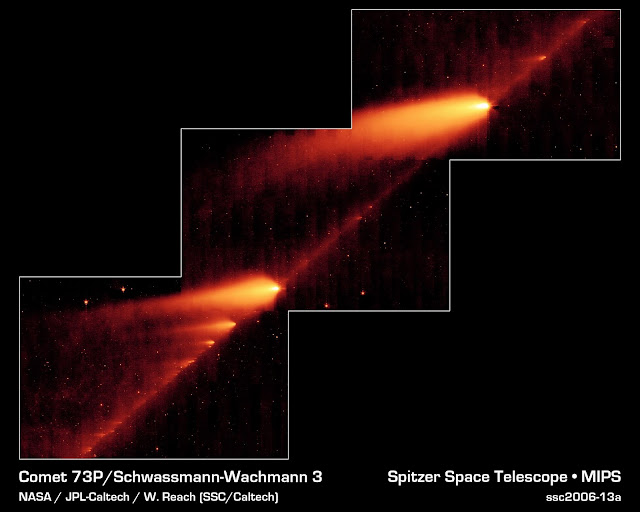
The hazard from fragmenting comets Last month, Bill Napier (co-creator of the coherent catastrophism theory, with Victor Clube) published his latest paper (MNRAS, vol. 488, p 1822-1827) on the impact hazard from disintegrating comets in the inner solar system. His focus is on a large 100 km comet in an Encke-like orbit. It is a sophisticated work that extends his earlier estimates, this time by combining explicit orbital simulations with a calibrated model of comet fragmentation (published by de Sisto et al. in 2009). His aim, like mine in Prehistory Decoded, is to estimate the hazard to Earth from the kind of comet thought to have become trapped in our inner system a few tens of thousands of years ago. We know, pretty much, that this happened because of the massive zodiacal dust cloud and correlated fragments that remain in orbit. He concludes that we can expect one or two impact collisions over the last 20,000 years, or so, with energy over 6000 Mt, and that this energy wil...
Image
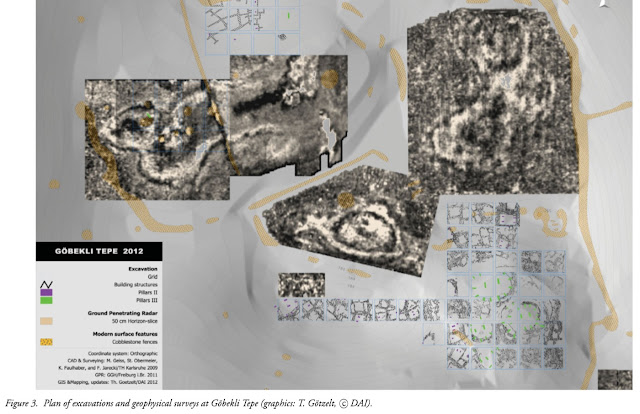
Gobekli Tepe is huge! This is for the benefit of those that haven't yet seen the subsurface radar scan of Gobekli Tepe. The above image is from Deitrich et al., Antiquity vol. 86 (2012), freely available on the internet. The little portion of Gobekli Tepe so far excavated corresponds to the detailed portion of the map, bottom right, which includes the main circular enclosures A to D. As you can see, even Enclosure D, the oldest and largest enclosure yet uncovered, corresponding to the uppermost green circle is small relative to some of the remaining structures. The structure right in the middle of the plot looks especially interesting  - being nearly twice the diameter of enclosure D. Considering the progression of these structures - they seem to get larger as they get older - perhaps this central enclosure is the 'heart' of Gobekli Tepe, and will reveal a great deal more about its function and purpose. But some of the other structures remaining in the ground al...
Image
Zodiacal dating the Gundestrup Cauldron Interior of Panel A of the Gundestrup Cauldron, image from Wikipedia The Gundestrup Cauldron is a fantastic piece of  large, intricate silverware, weighing around 7 kilos. It was found in a Danish bog in 1891, but its manufacture is thought to date to the first few centuries BC, or perhaps slightly after. It is formed from several panels displaying mythological scenes, including many animals and humanoid faces. The main panel that concerns us is the interior of Panel A, shown above. This particular panel is very similar to the Pashupati Seal, which features in Prehistory Decoded (shown below). Pressing from the Pashupati Seal, Mohenjo-Daro, India, image from Wikipedia. The Pashupati Seal possibly shows an early version of Shiva, known as Rudra, an Indian horned god, surrounded by animals. The zodiacal date of this seal is given in Prehistory Decoded as around 1950 BC, to within a few hundred years, which agrees with i...
Image
Zodiacal dating the Burghead Bulls A Pictish (Burghead) bull symbol stone in the National Museum of Scotland The Pictish bull symbol has had a hard time justifying itself. Jackson (in The Symbol Stones of Scotland) claims it is not a Pictish symbol at all, because it never occurs in a pair - which is his definition of a Pictish symbol. Cummins (in The Picts and their Symbols) makes no mention of bull symbols at all. This is despite around 30 'individual' bull symbols being found at Burghead that have the same style as all the other Pictish symbols. Only 6 of these symbols have survived (one is in the National Museum of Scotland - see above). Burghead is the site of an ancient Pictish fort, thought to be the oldest and largest Pictish site of all. While radiocarbon evidence suggests the ancient fort dates back to the 5th century BC, much older iron age and even bronze age finds have been uncovered nearby, indicating the area was occupied from a very early time. Apar...